Context
Buli is a rubble and construction-waste removal company operating in and around Warsaw, without a break, since 1993. That track record comes with real scale: more than 40 trucks, over 550 containers in constant rotation, Big-Bag and container rental, plus waste collection and disposal across roughly 25 locations. Its ~4.6★ Google rating is the product of three decades of steady, repeatable work — not a marketing campaign.
An operation like this isn’t one office fielding a handful of jobs a day. It’s dozens of vehicles that have to be positioned across the city, hundreds of containers whose whereabouts and return dates need tracking, and a stream of orders that can’t afford to stall. The company needed a single place to keep all of it under control — from the moment an order comes in to the point the run is settled.
Problem
Buli wasn’t starting from a blank page. It had already been through a failed rollout of an earlier CRM — a system meant to bring order to the work that instead became the bottleneck. It was poorly designed, awkward in day-to-day use and, most costly of all, effectively impossible to grow. Every attempt to add a feature the expanding operation demanded ended in a workaround.
As a result, the core processes drifted back to where they were supposed to disappear from: Excel and informal arrangements. Ordering containers, planning runs, coordinating the fleet — all of it scattered across spreadsheets and individual people’s heads. At this scale that isn’t just an inconvenience. It’s real risk: a wrong address, a duplicated run, a container “lost” in the system for days.
We began with a review of what was already in place. We had no interest in forcing a rewrite for its own sake — the honest first question was whether the existing system could be brought into shape at all. The answer was clear-cut:
Continuing to patch a badly laid foundation would cost more than building a new one.
We recommended building from scratch. Not because that’s the easier path for a software house, but because it was the only one that would deliver a system still keeping pace with the company a year or two out, rather than becoming a brake all over again.
Solution
We built a dedicated operations system that brings the entire order workflow into one place. The key modules:
- Container ordering — a structured path from intake to fulfilment, instead of rows in a spreadsheet.
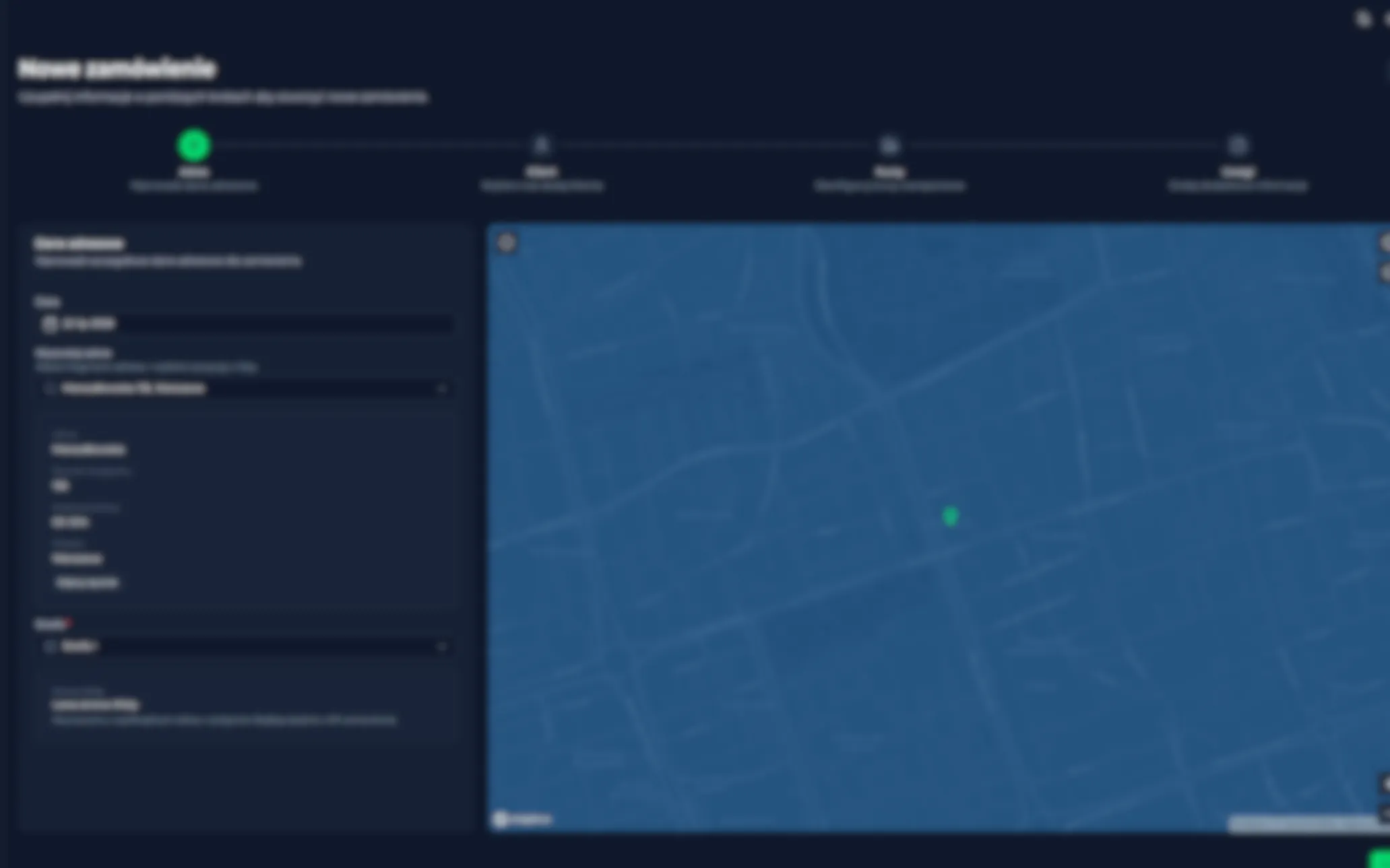
- Interactive dispatch map — a single view of where vehicles and containers are, and a way to plan runs from it.
- Admin panel — data, orders and system configuration managed in one place.
- User roles — different permissions for different jobs, so each person sees exactly what their work requires.
- Automations — repetitive steps that used to be done by hand now happen on their own.
Under the hood, the stack was chosen for the job rather than for fashion: Nuxt 4 on the front end and Node.js with Express on the server. The work ran across 2025–2026.
But the modules are only half the story. On a project replacing a system that had already been written off as a failure, how you work matters just as much. We started with discovery — reviewing the existing solution and the company’s processes — to understand what genuinely had to work before writing a line of code. From there we worked iteratively: the client had access to a staging environment, could see progress as it happened and react before a feature ever reached production. No black boxes, no “you’ll see it at the end.”
Outcome
The most important result is a qualitative one: the company has fully moved off Excel and onto a dedicated system. Ordering and coordination no longer live in spreadsheets and individual memories, but in one shared tool that grows alongside the operation.
The numbers, drawn from a before-and-after comparison of the work, back that up:
- Order entry time cut by 70% — what once meant clicking through spreadsheets and making phone calls is now a single, structured path.
- Order errors down by 48% — fewer mistakes in addresses and runs means fewer costly return trips and roadside fixes.
The system isn’t a “delivered and closed” project. We continue to develop it and provide long-term support — because just as Buli has been growing since 1993, the tool it works with is meant to keep pace with the years ahead, not age out in one.